06 October, 2026
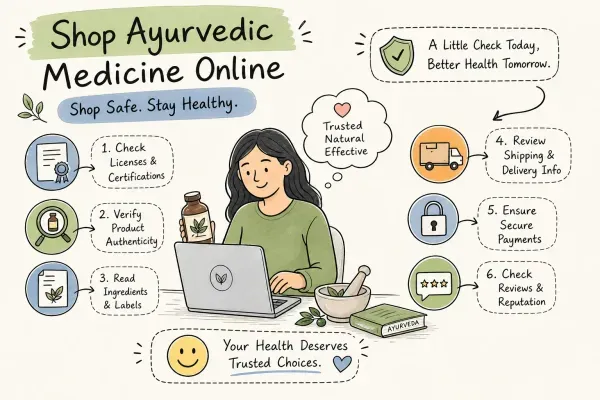
After years of sourcing and shipping classical Ayurvedic formulations to customers across the U.S., I've seen the same mistakes repeat. Buyers land on a product page, like the photo, and click purchase without checking a single credential. That's how you end up with a bottle that's a knockoff of a trusted Indian brand, a package seized at a U.S. port of entry, or worse, a supplement that later tests positive for undeclared heavy metals.
When you shop Ayurvedic medicine online, those risks are real, but they're navigable once you know what to look for. At Oyurveda, we advise customers on import responsibilities before they place an order, a step most international Ayurvedic retailers skip entirely. This guide gives you the exact checklist: how to read a label, which product categories carry higher risk, what U.S. customs will and won't let through, and how to find a source you can actually trust.
Many buyers skip straight to the product photo and price. The label is where the real due diligence starts, and it takes less than two minutes once you know what to scan for.
An AYUSH manufacturing license is issued by the relevant State AYUSH or Drug Licensing Authority in India and confirms that the manufacturer is authorized to produce Ayurvedic medicines under Indian regulatory oversight. The license number, manufacturer name, facility address, and validity date should all appear on the label or packaging. You can cross-check the license number on the official AYUSH portal to confirm it's current and matches the product category, it takes just a few minutes and immediately filters out unregistered manufacturers. Few buyers know this verification step exists, but it's one of the fastest ways to separate credible products from counterfeits.
A label that just says "Ashwagandha" tells you almost nothing. A reputable manufacturer will list the full Latin binomial name, the plant part used (root vs. leaf), the extract ratio, and the standardized active-compound content, such as a withanolide percentage for ashwagandha. These details matter because therapeutic effect is dose-specific. A root extract standardized to 5% withanolides is a fundamentally different product from an unlabeled powder of unknown composition. This level of labeling transparency is what distinguishes quality Ayurvedic herbs online from generic, poorly sourced alternatives.
A Certificate of Analysis (CoA) is a batch-specific test report from a laboratory. The CoA's product name and batch number must match the package you're receiving; a generic company-level certificate is not the same thing. Prefer testing from a laboratory accredited to ISO/IEC 17025, and check that it's an independent third-party lab rather than the manufacturer's own in-house facility. The key tests to look for are heavy metals (lead, mercury, arsenic, cadmium), total microbial count, absence of pathogens like Salmonella, and pesticide residues. Any seller who can't provide this on request is a seller you should skip.
Knowing what you're actually looking for before you search saves a lot of confusion. Many buyers land on a product page without knowing the difference between a churna and a rasayana, and that gap leads to wrong purchases.
These three commonly searched categories each cover distinct health goals. Digestive formulas, like Triphala and Hingwashtak Churna, support gut motility, elimination, and digestive fire. Respiratory formulas, like Talisadi Churna and Sitopaladi Churna, are classical preparations used for cough, congestion, and upper respiratory support. Rasayanas, including Chyawanprash and Brahma Rasayana, are rejuvenating formulas traditionally used to build immunity and vitality over time. They're not quick-fix supplements; they're meant to be used as part of a longer wellness practice.
Tablets and capsules offer convenience and precise dosing. Churnas (powders) follow traditional preparation methods and are typically mixed with warm water, honey, or ghee before consumption. Arishtas and asavas are fermented liquid formulations with a small natural alcohol content that acts as a preservative and carrier. They're classical dosage forms used for specific conditions and may have longer shelf life in some formulations due to their natural fermentation content, though actual shelf life varies by formulation and storage conditions, so always check the expiry and batch data. Bhasmas, calcined mineral preparations, require the most scrutiny before purchasing; metals in these preparations may be intentional ingredients rather than accidental contaminants, which makes independent heavy-metal testing non-negotiable for this category.
The supply chain for Ayurvedic herbs online has real quality gaps, and naming them plainly is more useful than pretending they don't exist.
Ashwagandha root is one of the most frequently substituted herbs; cheaper Ipomoea or Aerva species are common replacements that deliver a completely different chemical profile. Shatavari is often substituted with other Asparagus varieties. True cinnamon (Cinnamomum verum) gets replaced with cheaper cassia bark, which contains substantially higher coumarin and carries greater liver risk with prolonged use. Black pepper gets mixed with papaya seeds. These substitutions aren't minor, they change the therapeutic action entirely because the active compounds are species-specific.
Several bestselling Ayurvedic products have documented interactions with common medications. Ashwagandha should be avoided during pregnancy and used with caution alongside thyroid medication and sedatives. Licorice root can raise blood pressure and deplete potassium, which becomes dangerous when combined with diuretics or digoxin. Guggul may interact with anticoagulants and thyroid medicines. Concentrated turmeric or curcumin extracts can amplify the effects of blood thinners like warfarin, with cases of markedly elevated INR on record.
The FDA has specifically warned that some imported Ayurvedic products contain hazardous levels of heavy metals and that no Ayurvedic product is FDA-approved. That's not a reason to avoid Ayurveda, it's a reason to buy from a verified source and disclose what you're taking to your physician.
This is the section most buying guides skip. Knowing the regulations before you order protects both your health and your package from seizure.
U.S. law has no standalone "Ayurvedic medicine" category. Most Ayurvedic products enter the country as dietary supplements under DSHEA (the Dietary Supplement Health Education Act), which means they're regulated as supplements to the diet, not as drugs. The classification shifts the moment a product makes disease-treatment claims, such as "cures arthritis" or "treats diabetes." At that point, the FDA may treat the product as an unapproved drug, making it subject to detention or seizure at the port of entry. Any ingredient not commercially sold in the U.S. before October 15, 1994, may also require a New Dietary Ingredient (NDI) notification from the manufacturer before it can be legally marketed here.
Certain product types consistently attract FDA scrutiny at import. These include products with undeclared heavy metals or pharmaceutical adulterants, ephedra-containing formulas, bhasma and rasa shastra preparations, concentrated plant extracts with disease claims, and anything making sexual enhancement or rapid weight-loss promises. Before ordering from any online Ayurvedic pharmacy or Ayurvedic supplements store, request the full ingredient list with scientific names and verify that no ingredient falls into a restricted category. A foreign AYUSH license or traditional-use history does not substitute for U.S. regulatory compliance; what's legal to manufacture in India isn't automatically admissible in the U.S.
A reliable source will clearly display the manufacturer's name and address on each product page, along with batch number and expiry date either on the packaging or available on request. CoA access, a clear return or reship policy, and tracked international shipping are non-negotiable markers of a credible operation. Red flags include missing manufacturer information, disease-cure claims on product descriptions, and prices that seem impossibly low for established classical formulations from brands like Dabur, Baidyanath, or Kerala Ayurveda. Suspiciously cheap pricing is often the first sign of a knockoff or an expired product being moved at discount.
Oyurveda sources authentic classical formulations from trusted Indian manufacturers and ships internationally, with typical delivery to U.S. customers in 5 to 10 business days depending on customs clearance. Oyurveda advises customers about import responsibilities upfront, a level of transparency that's not standard practice across most international Ayurvedic retailers. For reference, fair pricing on common bestsellers from Indian online stores runs approximately $6 to $16 for Triphala, $5 to $25 for Ashwagandha tablets or capsules, $9 to $25 for a 500g jar of Chyawanprash, and $20 to $35 for Ashokarishta. Shipping and any applicable customs duties are typically added on top of product prices, so factor those into your total order budget. If you're seeing prices well below these ranges from an unfamiliar source, that's worth investigating before you buy.
A practitioner consultation isn't a bureaucratic hurdle. It's a practical step that protects both your health and your investment by ensuring you're ordering the right formulation at the right dose.
Certain situations make self-guided Ayurvedic supplementation genuinely risky. These include pregnancy, active liver or kidney disease, and anyone currently taking anticoagulants, thyroid medication, diabetes drugs, or sedatives. Children under 12 and individuals with autoimmune disease also fall into this category. Many classical formulations have documented pharmacological activity that can amplify or interfere with prescription drugs in ways that aren't obvious from a product description. The interaction data for ashwagandha with thyroid hormones, licorice with potassium-wasting diuretics, and curcumin with warfarin are all well-established, exactly the kind of interactions a qualified practitioner will flag before you order.
NAMA, the National Ayurvedic Medical Association, is a reliable starting point for locating a credentialed practitioner in the U.S. Many now offer telehealth consultations, which makes access practical regardless of where you live. A short consultation before placing your first order is worth the investment; it narrows down the right formulation, clarifies appropriate dosing, and helps you avoid spending money on products that aren't suited to your constitution or current health situation.
When you shop Ayurvedic medicine online, the market rewards buyers who do their homework and punishes those who don't. If you're ready to place your first order from a verified source, reach out to the Oyurveda team directly with your questions. Tell us what you're looking for and we'll confirm what's admissible for your destination and which formulations fit your situation. Getting Ayurveda right starts with buying it right.